


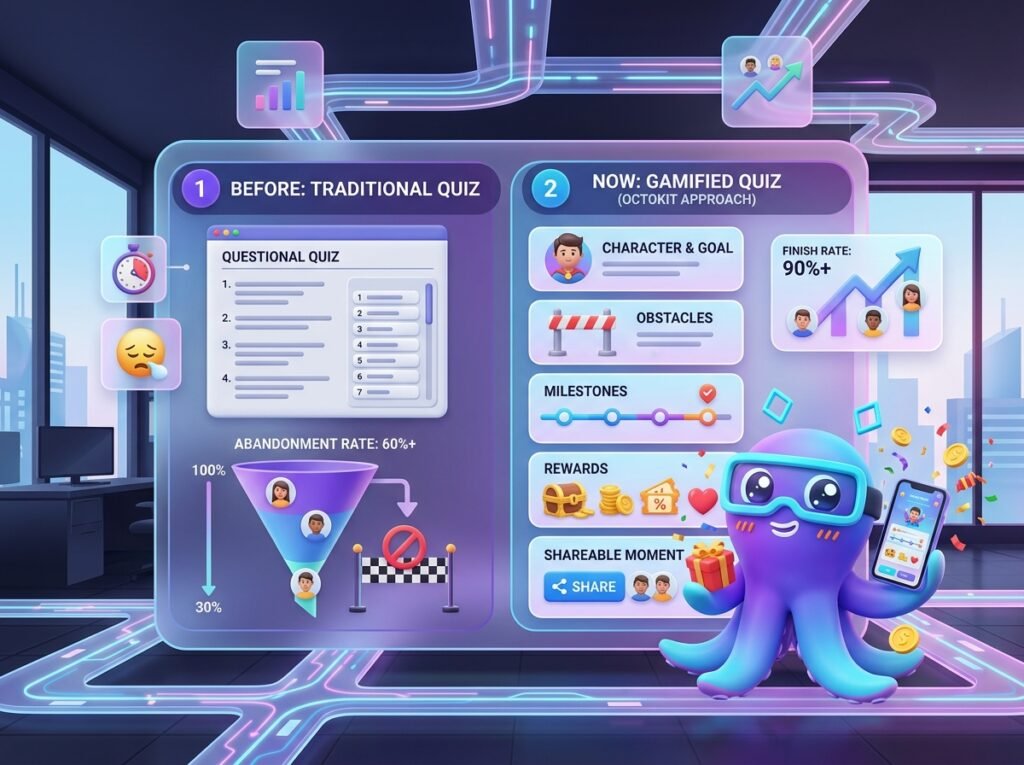
The average quiz loses more than half its participants before the final question.
This isn’t a content problem. The questions aren’t too hard or too boring. It’s a design problem — and game designers have been solving it for decades.
Games routinely get people to complete 30, 60, even 100 hours of content voluntarily. A 10-question quiz that fails to hold attention for 3 minutes is not a hard problem by comparison. But most quiz designers aren’t using the tools that make games work.
This guide applies those tools directly to quiz design.
Why Most Quizzes Fail
Before the fixes, the diagnosis.
Problem 1: No pacing. A standard quiz presents 10 questions at the same emotional register, the same visual format, the same interaction pattern. The brain habituates — it starts predicting what comes next and disengages.
Problem 2: No stakes. A quiz with no consequences for wrong answers, no sense of progress, and no narrative context removes the cognitive tension that keeps people engaged. You’re answering questions in a vacuum.
Problem 3: No reward intervals. Game designers know that players need a “win moment” roughly every 2–3 minutes or they start to drift. A quiz that saves all satisfaction for the final score screen is front-loading all the friction and back-loading all the reward.
Problem 4: Front-heavy friction. The first 3 questions determine whether someone finishes. If the opening is slow, generic, or fails to establish why the quiz matters — most people leave before question 4.
The Game Design Principles That Fix These Problems
Principle 1: Vary the Emotional Register
In game design, level designers alternate between tension and release — a difficult section followed by a breather, then a buildup, then a payoff. They never hold maximum tension indefinitely, because players burn out.
Applied to quiz design:
Don’t give 10 questions of equal difficulty. Structure your quiz like a game level:
- Q1-2: Accessible, confidence-building (easy win to establish momentum)
- Q3-5: Moderate challenge (builds engagement)
- Q6-7: Peak difficulty (maximum investment)
- Q8-9: Slightly easier (relief after the peak)
- Q10: Satisfying conclusion (resolves with a clear answer, not ambiguity)
This isn’t “making it easier.” It’s pacing. The total difficulty can be identical; the experience is dramatically different.
Principle 2: Create Stakes Through Narrative Context
In a game, a quiz question isn’t just a question — it’s a moment in a story. A villain challenges you to answer correctly to proceed. A mentor tests you before granting access to the next area. The stakes are embedded in the context.
Applied to quiz design:
Frame your quiz inside a scenario. Instead of:
“Question 4: Which ingredient is found in our moisturizer?”
Try:
(After a character encounter) “The lab technician looks skeptical. ‘Tell me — what’s the active ingredient that makes this formula work?’ Your answer determines whether they trust you.”
The question is identical. The engagement is different because the answer means something in context.
This is exactly what Octokit’s dialogue-quiz slide mix achieves — a character speaks, creates a moment of tension, and then the quiz question appears. The question inherits the emotional investment from the story beat before it.
Principle 3: Add Reward Intervals
Don’t save all satisfaction for the end. Distribute small wins throughout the quiz.
Types of reward intervals:
- Immediate feedback with flavor text: Not just “Correct!” but “Correct! That’s exactly what distinguishes our formula from competitors.” Every right answer teaches something while rewarding.
- Progress milestones: “You’re halfway there — and you’ve scored higher than 70% of participants so far.”
- Unlocks: Correct answers reveal an additional fact, image, or piece of narrative. The quiz becomes an information unlock mechanism.
- Score visualization: A visible score that ticks up in real-time (rather than revealed only at the end) creates ongoing motivation.
In Octokit, each encounter popup ends with a reward slide that adds points and lives. The player gets a tangible win after every encounter — not just at the final screen.
Principle 4: Solve the First 30 Seconds
Game designers call this the “tutorial problem” — if the first few minutes of a game don’t communicate what makes it worth playing, players quit. The same applies to quizzes.
Your first question must do three things:
- Be answerable with confidence (easy enough to not immediately frustrate)
- Establish the quiz’s “voice” and tone
- Hint at why completing this quiz is worth the player’s time
Bad first question:
“What year was our company founded?”
Good first question:
“If you could pick one word to describe what makes our product different from everything else on the market, which would you choose?” (Four personality-style options, all positive)
The second version has no wrong answer, sets an engaging tone, and tells the participant this quiz is about them and their perspective — not just a test of memorized facts.
Principle 5: Design the End as a Payoff, Not a Report
Most quizzes end with a score: “You got 7 out of 10.” That’s a report.
A game ends with a scene: something resolves, something changes, the player feels like they accomplished something.
Quiz ending as payoff:
- Personalized result based on answers (not just score): “Based on your answers, you’re a [type]. Here’s what that means for how you use the product…”
- A narrative conclusion if you’ve used story framing throughout
- A meaningful CTA that flows from what the participant just learned: not “Visit our website,” but “You clearly know your stuff about [topic]. Here’s what our top [type] customers do next…”
The Structure That Works: A Practical Template
Here’s a repeatable quiz structure that applies these principles:
[Opening hook — 1 question or narrative intro]
→ Confidence-builder, establishes tone, low friction
[Build phase — 3-4 questions]
→ Moderate difficulty, vary format (single choice, image choice, slider)
→ Add 1 reward interval at midpoint (“You’re doing well — here’s a fact…”)
[Peak phase — 2-3 questions]
→ Highest difficulty, most brand-relevant content
→ Use narrative framing for at least 1 question (character speaks, then asks)
[Wind-down — 1-2 questions]
→ Slightly easier, builds toward resolution
→ Add final reward interval before last question
[Payoff ending]
→ Personalized result (not just a score)
→ Narrative resolution if story framing was used
→ High-relevance CTA that flows from the result
Applying This to Different Quiz Types
Brand knowledge quiz
Pace difficulty around product complexity. Use the “character encounter” framing to make product facts feel like story moments rather than a test. Reward correct answers with additional product information (the quiz becomes a learning tool, not just a filter).
Lead qualification quiz
Your questions are screening for persona fit — but the participant doesn’t need to know that. Frame questions as preference choices (“Which of these resonates with your current situation?”) rather than direct questions. The opening should feel like a consultation, not an intake form.
Training and L&D quiz
Vary format between recall questions (what you know) and application questions (what you’d do). Add scenario-based questions — “Your client says X. What do you respond?” — which test actual competence, not memorization. Reward intervals here should include “explanation of why” for each correct answer, building the knowledge as the quiz progresses.
Event activation quiz
These are often time-limited (people are standing at a booth or attending an event). Keep it to 5-6 questions maximum. Use simple, fun first questions to draw people in. Make the reward instant and tangible — not “we’ll email you your results.”
The Format Problem: Why Multiple Choice Grids Underperform
A grid of 4 options looks neutral but reads as low-stakes. The participant’s eye immediately scans all four options, shortcuts to the one that looks most plausible, and clicks. No genuine thinking occurs.
Alternatives that increase engagement:
- Image choices: “Which of these images best represents how you feel about X?” (forces genuine evaluation)
- Slider: “On a scale of 1-10, how would you rate…” (creates personal investment in the response)
- Ranking: “Put these in order of importance to you” (higher cognitive load, higher engagement)
- Open-ended short text: Used sparingly — 1 open question in a 10-question quiz feels like a conversation, not a test
In Octokit’s quiz slide type, you can combine these with dialogue framing — a character speaks, poses the question, and the player sees their options in context. The grid problem goes away because the question is embedded in a scene.
FAQ
How long should a quiz be? For brand campaigns and lead gen: 5-8 questions is the sweet spot. Under 5 feels too easy to generate meaningful data; over 10 sees steep drop-off. For training and L&D: up to 15 questions is acceptable if the content is genuinely engaging and rewards are well-placed.
Should I show the correct answer immediately after each question? Yes, for educational and brand knowledge quizzes — immediate feedback is a core engagement mechanic. For lead qualification quizzes where questions are preference-based rather than factual, immediate feedback doesn’t apply.
How do I reduce drop-off on mobile? Keep questions short (under 20 words). Use large tap targets for options. Don’t require scrolling within a single question. If your quiz has images, ensure they’re optimized for mobile load speed.
What completion rate should I aim for? Industry average for standard marketing quizzes is 35-50%. With game-design principles applied (narrative framing, reward intervals, pacing), 60-75% is achievable. Completion rates above 70% typically indicate strong alignment between audience, content, and format.
Can I use narrative framing in a simple quiz tool? Most quiz platforms don’t support this. Octokit’s dialogue-quiz slide mix is specifically designed to let you wrap quiz questions inside character encounters — the narrative framing is built into the content type.
Build a Quiz That People Actually Finish
 Back
Back